


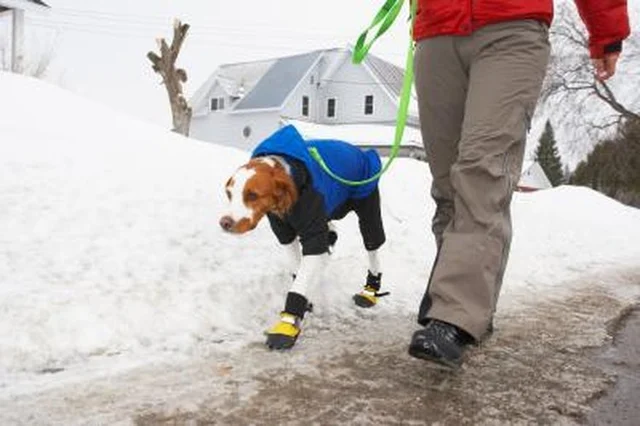
Your best buddy loves going with you everywhere, but trekking through the icy snow or over rocky terrain on a nature hike can wreak havoc on his foot pads. Make a pair of traction boots for your dog to protect his paws and help him get a grip.
Choosing the Material
If you and your dog will mostly be walking in snowy or wet weather, you'll want to make his boots out of a water-repellent material such as nylon. Ultra-cold weather calls for an insulating liner, too, such as fleece. The pooch who hikes in warmer, drier climates will want a traction boot that breathes to keep his paws cool and comfortable, such as large-weave material like canvas.
The Traction Element
Don't be stumped by what type of material to use on the bottom of your dog's boots to give them traction. Commercially made traction booties use strips of mohair on the bottoms to make them non-slip. Other useful materials are suede or rubber. If you want to go with rubber, don't start hacking up your old bike tires. A rubber jar opener is ideal for giving your dog's boots traction because it's sturdy yet flexible, and the texture on the surface is custom-made for gripping.
The Fit
You may have to make more than one attempt a DIY traction boots for your dog to get the fit just right. Your dog needs boots that are snug without being too loose or too tight. In his 2010 book "Best Hikes with Dogs Western Washington," Dan Nelson pointed out that just as with your hiking boots, dog boots that are too tight can cause circulation problems; ones that are too loose can cause sores and blisters on your dog's feet.
Keeping Them Snug
Laces on dog traction boots aren't an efficient way to keep the footwear in place. You'll want something that will keep them snug while facilitating quick dressing and undressing of your dog's paws. Velcro is the perfect solution. It fastens in one smooth motion and can be easily adjusted if the boots are too tight or too loose. Place Velcro strips just above the "wrist" section on each boot so your dog can bend his wrists naturally as he walks, runs and climbs.
